
Give a frontier language model a dense, factual paragraph (say, the architecture brief for a distributed database node or the release notes for an API gateway) and ask it to rewrite the copy for a public landing page.
Within three seconds, it will hand you back a minor tragedy.
The software is no longer a tool. It is now “a testament to modern engineering, meticulously crafted to seamlessly elevate your digital ecosystem.” Every sentence will hover around eighteen words. Every paragraph will lean on an unspaced em-dash. And if you look closely at the bullet points, you will discover the model quietly rounded your 99.95% SLA and 12,400 req/s throughput limit into “blazingly fast enterprise reliability” because it thought the numbers ruined the vibe.
The word humanization has a terrible reputation. Search for it today and you will land in a swamp of $49-a-month wrapper sites promising to help undergraduates smuggle a ChatGPT essay past Turnitin by swapping every fourth adjective for a weirder synonym.
That is not humanization. That is just vandalism with a Stripe checkout.
In real editorial, engineering, and marketing work, humanization is a systems problem. We don’t use language models because we want machines to do our thinking; we use them because nobody has six months to manually rewrite four thousand legacy documentation pages, translate knowledge bases across five languages, or weave search entities into sprawling content archives by hand. The goal of humanization isn’t to trick a teacher. It is to take machine-assisted prose and make it readable, stylistically sharp, statistically un-watermarked, and factually indestructible.
Why we actually need to humanize text
If you strip away the academic-cheating industry, there are three completely legitimate reasons a team sits down to build a text rewriting pipeline:
- Rewriting into a specific house style. Out of the box, frontier models suffer from terminal RLHF politeness. They write like an eager committee of corporate communications managers. Whether you are turning rough engineering notes into a crisp essay, or adapting legacy copy into an understated brand voice, raw model output will flatten your personality in a single paragraph.
- Translation that doesn’t read like “Translationese.” Direct neural translation is grammatically accurate and stylistically dead. It carries the sentence cadence and idioms of the source language straight into the target language. True localization requires a secondary rewrite pass to restore natural native rhythm – without losing the underlying meaning.
- High-intent SEO rewrites. Legacy archives and product catalogs are usually starved of structured headings (
<h2>,<h3>), clean meta descriptions (130-175 characters), and natural semantic entities. You need a model to help restructure the prose for search intent without turning the page into repetitive keyword sludge that makes a human reader close the tab in four seconds.
The four traps of raw machine prose
Why can’t you just hook an API key up to your database, loop over the rows, and push to production? Because raw LLM output fails in four distinct, predictable ways.
1. The “delve and tapestry” slop (Perplexity and Burstiness)
Language models are autoregressive next-token predictors. Left to their own devices, they hug the peak of the probability curve. In information theory, this produces text with uniformly low perplexity (the model is never surprised by the next word) and flat burstiness (zero variation in sentence length and cadence).
Humans write in bursts. We write a thirty-two-word technical sentence explaining how a replication lock fails under load, and follow it with a three-word punch. It runs cold. Machines write in a hypnotic, metronomic hum: eighteen words, subordinate clause, unspaced em-dash (—), eighteen words. Even when a human reader cannot name the math, their eyes glaze over by sentence three. As Stanford researchers documented across thousands of peer reviews, models also leave glaring lexical footprints – an obsessive reliance on words like delve, testament, meticulously, underscore, and realm.
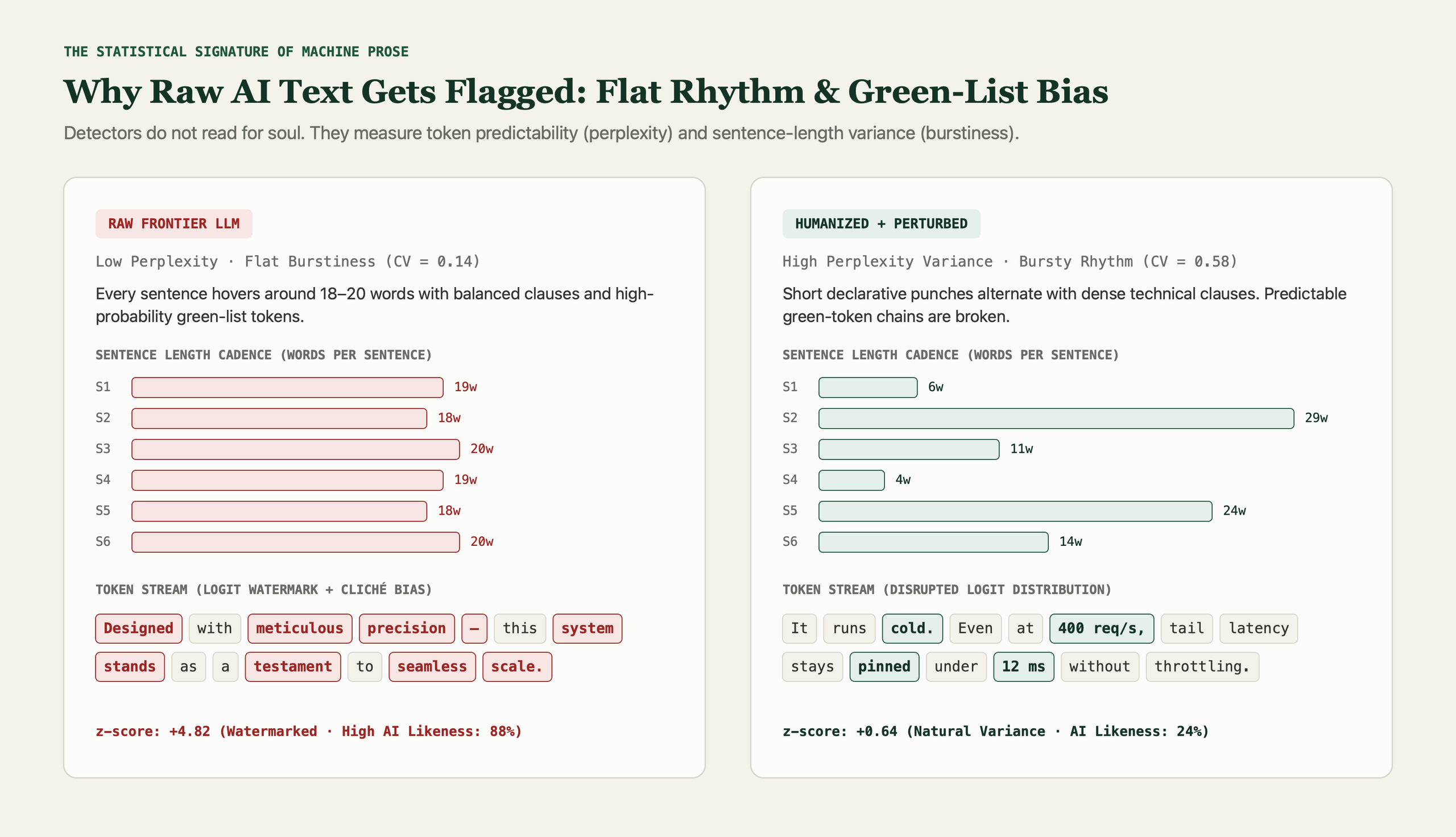
Detectors do not read for soul. They measure token predictability (perplexity) and sentence-length variance (burstiness).
2. Invisible ink: statistical watermarking
Many writers still believe that pasting AI text into Notepad or stripping HTML tags removes “the watermark.” It doesn’t. Modern text watermarks are not hidden metadata tags; they are woven directly into the mathematical choice of words.
The foundational design – introduced by Kirchenbauer et al. at the University of Maryland – works during the moment of generation. Before picking each token, the model hashes the preceding token with a secret key to split its vocabulary into a Green List and a Red List, softly biasing the probabilities toward the Green List. Google DeepMind’s production system, SynthID-Text (published in Nature), takes this further using tournament sampling via pseudo-random g-functions applied directly to the model’s logits.
To a human reader, the sentence looks normal. To a verifier holding the function, a 150-word block containing 78% green-list tokens yields a statistical z-score that is practically impossible for a human to type by chance.
3. Search engine pessimization (“Scaled Content Abuse”)
There is a persistent myth in marketing circles that Google runs a magic AI detector on every indexed URL and slaps an automatic penalty on anything written by a transformer.
In reality, search engines explicitly state they do not penalize AI provenance per se. What they penalize – aggressively, since the rollout of the Scaled Content Abuse policies – is low-information-gain statistical sludge. When three thousand pages share the exact same syntactic opener monotony, identical bullet-point symmetry, and zero original specificity, search algorithms don’t need to prove an LLM wrote it. They demote it because it looks like programmatic spam and users bounce immediately.
4. The Hallucination Tax
Here is the nasty catch-22 of text humanization: the harder you push a model to sound human, the more likely it is to lie.
When you raise the sampling temperature or prompt a model to “write with high burstiness and varied vocabulary,” you push it off its safe probability peaks. That is great for rhythm, and catastrophic for facts. Tell an unguarded model to humanize a technical document, and it will cheerfully invent ISO compliance ratings, alter pricing tiers, or mangle internal URLs.
The toolkit: local and free first (plus the best APIs)
You do not need a subscription to a black-box “humanizer” SaaS to solve these four problems. In fact, the best verification and perturbation tools run locally on an Apple Silicon laptop for zero dollars.
Here is how the stack breaks down across each layer – contrasting what you can run locally for free with the best commercial APIs when you need cloud scale.
1. Scoring & AI detection
To control AI-likeness, you first have to measure it honestly. Supervised classifiers (models trained on datasets of old GPT-3.5 essays) age like milk and famously falsely flag non-native English writers.
- Local & Free (The Gold Standard): Binoculars (Hans et al., ICML 2024). Instead of training a classifier, Binoculars runs two pre-trained open language models locally in tandem – an Observer (
M1) and a Performer (M2) – on Apple Silicon MPS or a local GPU. It computes the ratio between standard perplexity and cross-perplexity (how surprisedM1is by the predictions ofM2). Pair Binoculars with a Fast Statistical Profiler in Python (textstatfor Flesch reading ease, coefficient of variationCV = σ / μfor sentence burstiness, Shannon token entropy, and regex cliché counters) and you have a sub-second, 100% offline audit engine. - Best Cloud APIs: If a client requires a third-party commercial audit trail, Pangram Labs, Originality.ai, and GPTZero’s API are the current industry standards – though they charge per thousand words for math you can largely run on your own metal.
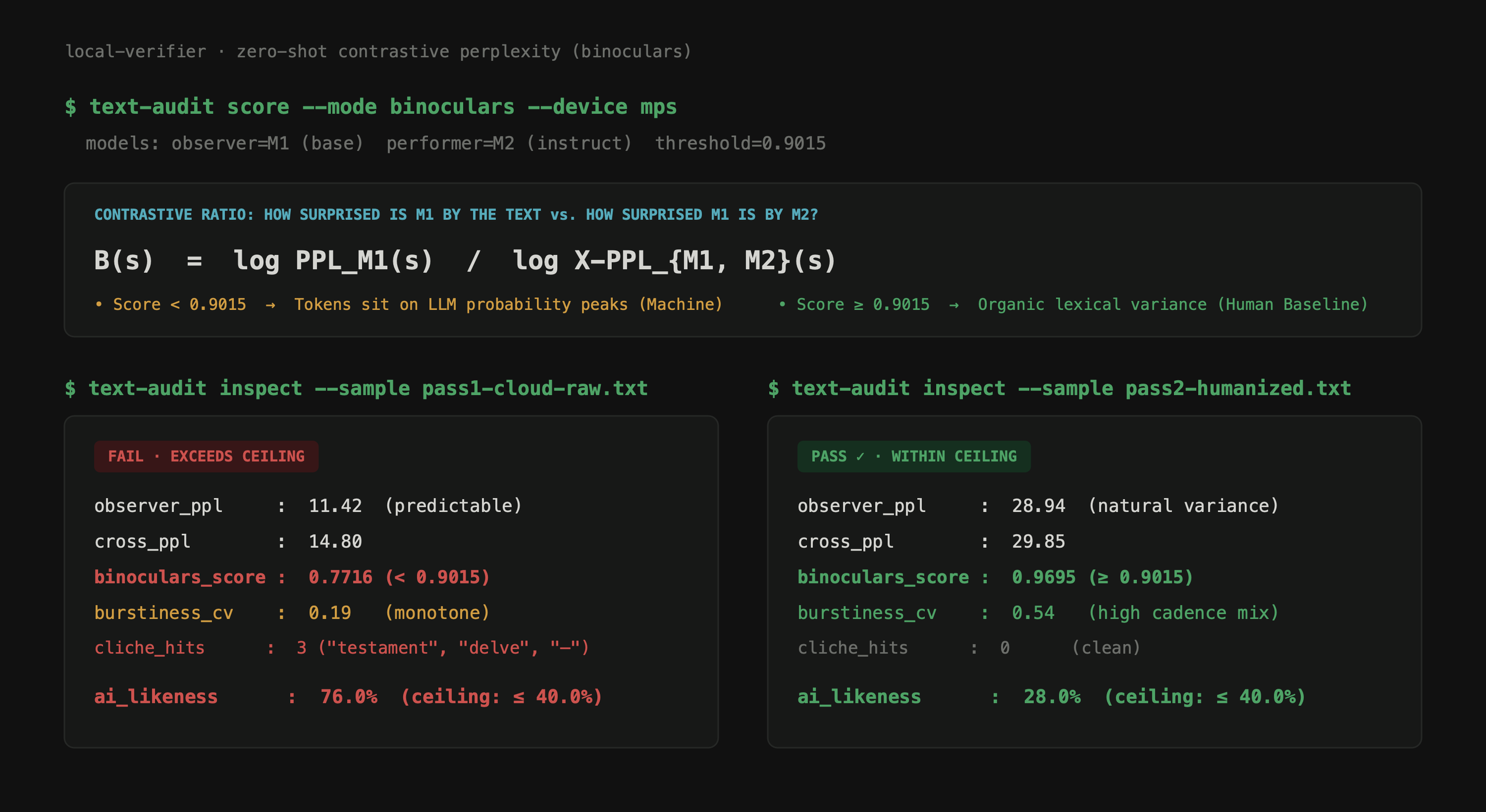
Running Binoculars locally: contrasting Observer and Performer perplexity catches machine predictability without sending a byte to the cloud.
Under the hood: The Binoculars math & Baseline + 10% rule
Binoculars evaluates a text string s by comparing its log-perplexity under an observer model M1 against the cross-perplexity of M1 and a performer model M2:
B(s) = log PPL_M1(s) / log X-PPL_{M1, M2}(s)When B(s) drops below the calibrated threshold (0.9015), the token choices sit suspiciously close to machine probability peaks.
Rather than chasing an unnatural “0% AI” score – which forces rewriters to produce bizarre, broken syntax – a sane production pipeline enforces a Baseline + 10% Ceiling:
AI_Score(rewritten) <= AI_Score(original) + 10%Technical writing is naturally dry and structured. If a human-written baseline document already scores 30% AI-like because it lists specifications, allowing the rewrite up to 40% keeps the prose clean without forcing the model to write like a beat poet.
2. Pass 1: Structural & semantic rewriting
The first pass isn’t about hiding tracks; it is about structure, tone adaptation, translation accuracy, and weaving search entities cleanly into the copy.
- Local & Free: Ollama running
qwenorllamamodels. Pro tip: if you use a reasoning-capable local model like Qwen 3.5 for copywriting, explicitly pass"think": falsein the API payload. Otherwise, the model will burn four minutes generating seven thousand internal chain-of-thought tokens debating paragraph transitions before outputting a single sentence. - Best Cloud APIs: Google and OpenAI models works fine for now, while Anthropic and Elon’s Grok turned on watermarking. Frontier cloud models still hold an edge in Pass 1 when you need them to juggle twelve simultaneous constraints (character-clamped meta descriptions, heading synchronization, and complex semantic cores) in one shot.
3. Pass 2: De-watermarking & burstiness perturbation
As Sadasivan et al. proved in their paraphrasing study, statistical watermarks like Kirchenbauer green-lists and SynthID rely on contiguous token sequences. If you pass watermarked cloud text through a secondary, distinct open-weight model instructed to vary sentence rhythm, the green-token z-score collapses toward random noise.
- Local & Free: A high-temperature (
0.75–0.85) micro-pass through local Ollama (qwen3.5:9b), followed by a Deterministic Python Scrubber. The Python script costs zero compute and does the unglamorous heavy lifting: replacing unspaced em-dashes (—→-), stripping banned RLHF phrases from a JSON blocklist, and enforcing custom glossary maps. (For extreme cases, cycling text through a local neural translator like Opus-MT or Meta’s NLLB-200 – English → German → English – completely scrambles logit watermarks). - Free Cloud APIs: Groq LPUs running open-weight models (
qwen3.8-27borgpt-oss-120b). Because Groq serves open-weight architectures on custom silicon at ~0.4 seconds per pass, you get local-model watermark disruption at ten times the speed, with local Ollama sitting quietly behind it as an automatic zero-downtime fallback whenever rate limits hit.
4. Hallucination prevention (Fact preservation)
Never ask an LLM to “be careful with the numbers.” It doesn’t know what a number is.
- Local & Free: Deterministic Token Masking (
ContentProtector). Before Pass 1 ever begins, a local Python parser scans the source document and extracts every fragile fact – metrics, pricing, API endpoints, HTML tables, URLs (href="..."), and quoted product names – replacing them with immutable placeholder tokens (__PROTECTED_SPEC_01__). The LLMs rewrite the prose around the tokens. Once Pass 2 finishes, the script restores the original bytes and runs a hardFactPreservationGateassertion. - Best Cloud APIs: Structured Outputs (JSON Schema) in OpenAI or Gemini, which lock the output structure so fields cannot bleed into one another, paired with deterministic post-generation regex verification.
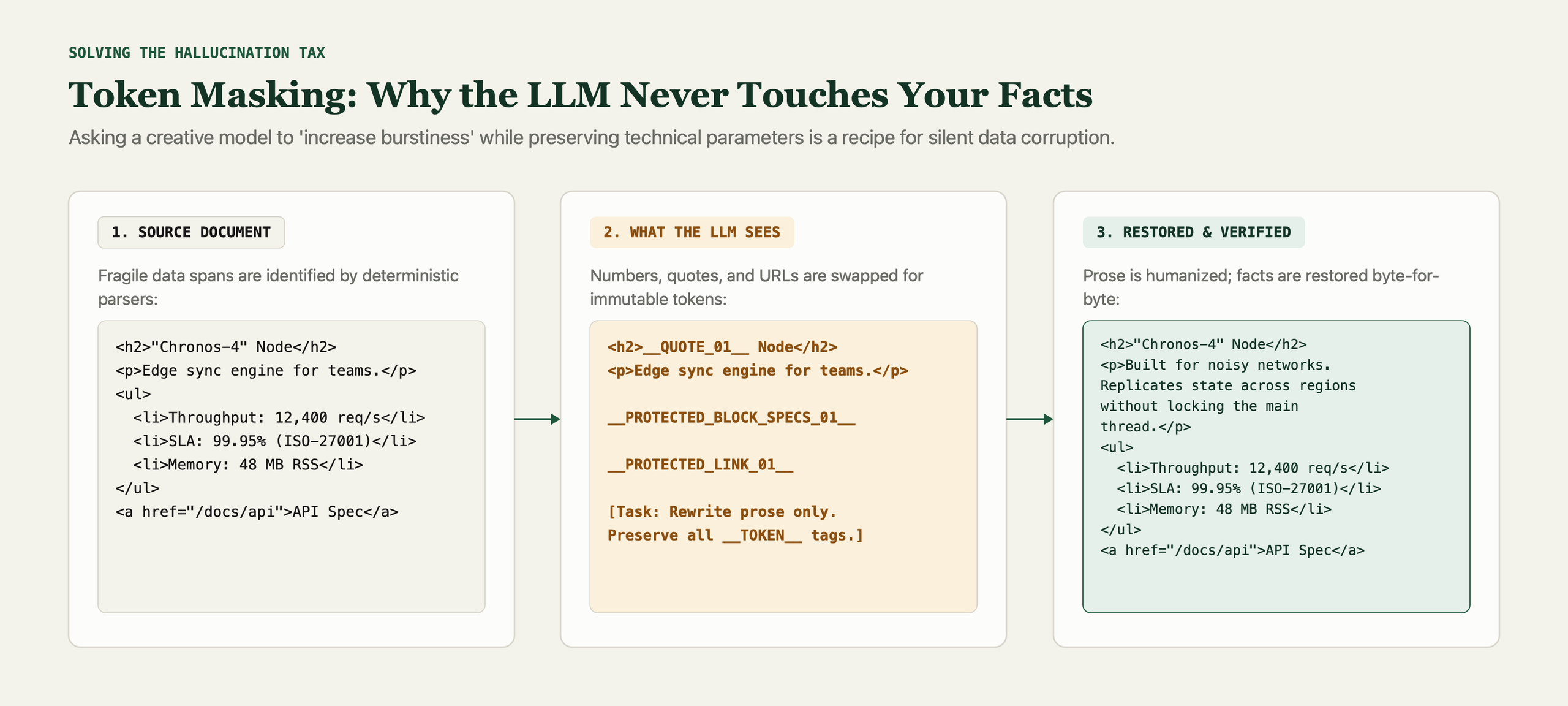
Token masking in three steps: extract fragile parameters before prompting, let the models rewrite the prose around placeholders, and restore facts byte-for-byte.
The blueprint: what a real rewrite workflow looks like
When you put all of these pieces on the same desk, humanization stops being a guessing game and becomes a six-stage assembly line:
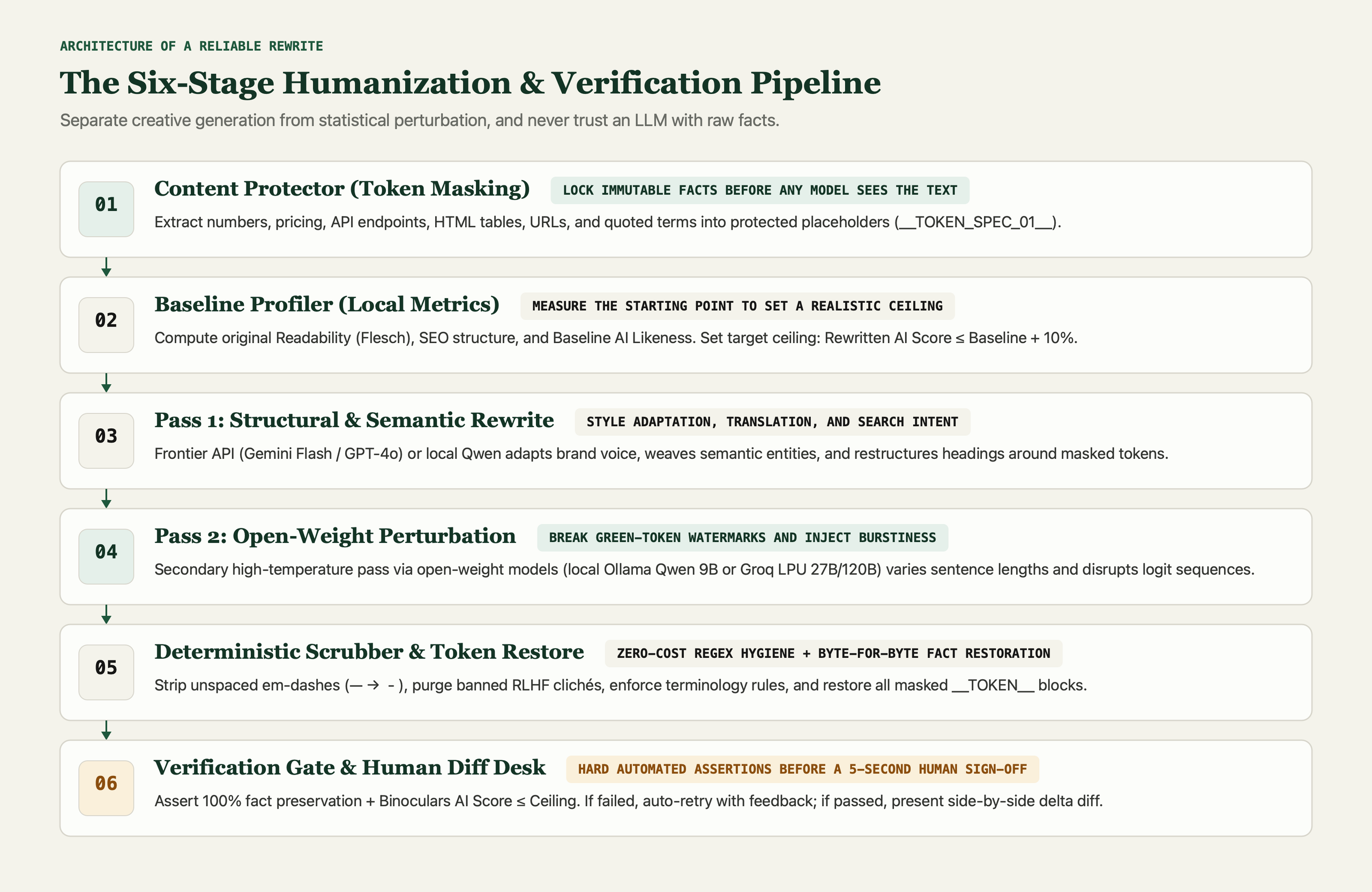
Separating creative generation from statistical perturbation – and locking technical facts behind a hard verification gate.
- Freeze & Mask. Lock every immutable fact, table, code snippet, link, and quoted name into tokens. Allow the operator to freeze specific fields (like canonical titles) so the AI never touches them.
- Profile the Baseline. Run the original text through the local scorer (Flesch readability, SEO entity density, and Binoculars AI probability) and store the baseline in SQLite. Establish the document’s personal ceiling (
Baseline AI % + 10%). - Pass 1 (The Architect). The primary model restructures the prose, adapts the style or translation, weaves in search keywords, and drafts character-bounded metadata.
- Pass 2 (The Humanizer). An open-weight model (via Groq LPU or local Ollama) perturbs the sentence cadence – breaking twenty-word monotone chains into a mix of punchy six-word statements and detailed clauses, erasing any cloud logit watermark in the process.
- Deterministic Scrubbing. A fast Python pass strips em-dashes, purges any surviving words from
banned_cliches.json, enforces terminology rules, and restores all masked__TOKEN__blocks byte-for-byte. - The Gate & The Desk. The engine scores the new draft against the baseline. If a single technical fact drifted, or if the AI likeness breached the ceiling, it flags or auto-retries. If it passes, it lands on the human operator’s screen as a clean side-by-side diff showing the exact score deltas (
ΔQuality,ΔSEO,ΔAI).
What I still refuse to automate
It is tempting to look at a six-stage pipeline with automated verification gates and ask why we don’t just wire Step 6 directly into the production database and go to the beach.
Because metrics are a floor, not a ceiling.
A draft can pass Flesch-Kincaid Grade 8, hit a 1.4% keyword density, score 0.96 on Binoculars, preserve every number in the specification block, and still contain a sentence that sounds slightly ridiculous to a human who actually knows the domain. Automated gates exist to filter out 95% of the mechanical garbage (the watermarks, the em-dashes, the hallucinated numbers, the “testaments to modern engineering”) before a human ever has to read the draft.
The machine does the heavy lifting in the back room. The final “Accept” button still belongs on a human desk.
Further reading & primary sources
If you want to poke at the actual math and policy behind watermarking, zero-shot detection, and paraphrasing attacks, start with these nine papers and references:
- Watermarking Foundations: Kirchenbauer et al. (2023), A Watermark for Large Language Models (ICML) – The paper that introduced Green/Red token list logit biasing.
- Production Watermarking (SynthID): Dathathri et al. (2024), Scalable watermarking for identifying large language model outputs (Nature, Google DeepMind) – How tournament sampling watermarks LLM text at scale without degrading latency.
- Watermarking Benchmarks: Piet et al. (2024), Mark My Words: Analyzing and Evaluating Language Model Watermarks (UC Berkeley) – Why watermarks need ~100 tokens and how they behave under tampering.
- Zero-Shot Detection (Binoculars): Hans et al. (2024), Spotting LLMs With Binoculars: Zero-Shot Detection of Machine-Generated Text (ICML) – Using contrastive perplexity between two local models to catch machine prose without training data.
- Probability Curvature: Bao et al. (2024), Fast-DetectGPT: Efficient Zero-Shot Detection of Machine-Generated Text via Conditional Probability Curvature (ICLR) – Why LLM word choices sit on local probability peaks.
- Paraphrasing & Evasion Limits: Sadasivan et al. (2024), Can AI-Generated Text be Reliably Detected? (Univ. of Maryland) – Empirical and theoretical proof of how secondary neural paraphrasing breaks watermarks and detectors.
- The “Delve” Footprint: Liang et al. (2024), Monitoring AI-Modified Content at Scale (Stanford, ICML) – Tracking the explosion of RLHF vocabulary clichés across corpora.
- False Positives on Non-Native English: Liang et al. (2023), GPT detectors are biased against non-native English writers (Patterns) – Why naive perplexity detectors punish clear, accessible international English.
- Search Engine Policy: Google Search Central, Guidance about AI-generated content & Scaled Content Abuse – Why search engines target low-value scaled permutations rather than AI provenance.